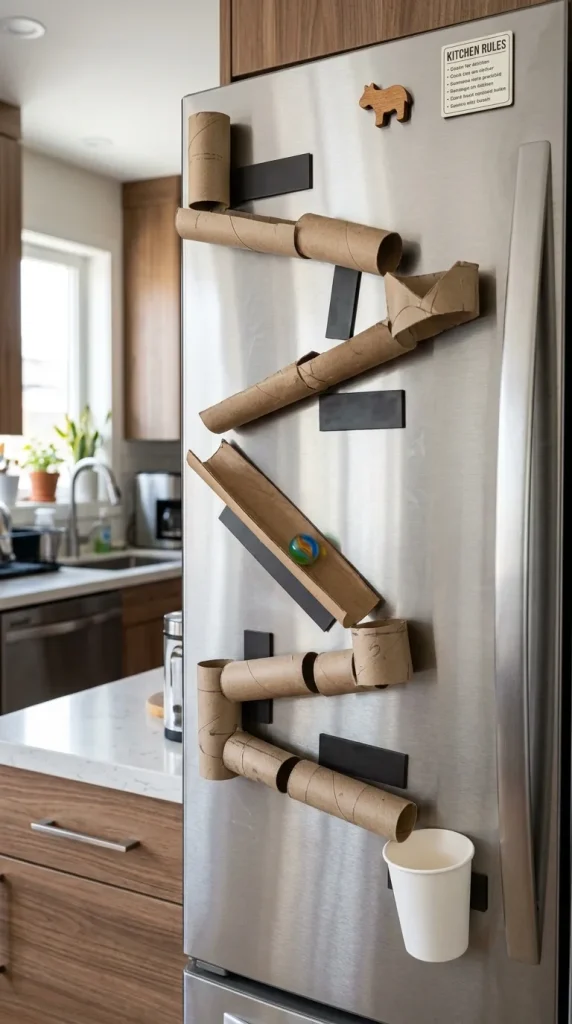
Transforming hollow cardboard tubes into kinetic marble run tracks turns ordinary recycling into an interactive engineering and physics lab for children. Cardboard tubes from paper towels, wrapping paper, and toilet tissue provide rigid, lightweight structural conduits that can be split into open half-pipe chutes, joined into enclosed tunnels, and angled to redirect speeding spheres. Instead of buying molded plastic track sets with rigid configurations, crafting custom cardboard runs allows young builders to experiment with gravity, momentum, friction, and slope gradients in real time. This comprehensive guide outlines the foundational mechanics of cutting, joining, stabilizing, and decorating cardboard marble runs across wall-mounted, freestanding, and tabletop formats. You will explore critical slope ratios, funnel junctions, track reinforcement techniques, and kinetic obstacles like spinners and trapdoors. Understanding structural balance, marble velocity control, curve bank angles, and vibration absorption ensures your handmade tracks deliver continuous runs without dead ends or derailments. Crafting cardboard marble runs provides an accessible, budget-friendly STEM activity that sharpens spatial reasoning, encourages iterative problem-solving, and delivers dynamic play.
Why This Idea Is Trending or Useful
Upcycled cardboard marble runs have become a staple across modern STEM education, homeschool activities, and maker spaces because they integrate foundational physics concepts with creative, hands-on construction. Cardboard tubes are free, abundant, and easily modified using standard child-safe scissors, hole punches, and craft tape. Rather than passively following rigid toy instruction manuals, children act as structural engineers—hypothesizing paths, testing marble speeds, diagnosing bottlenecks, and redesigning track slopes when a marble jumps the rail. In small apartments and classrooms, wall-mounted or door-hung vertical runs turn empty vertical planes into expansive play areas without occupying precious floor space. Furthermore, cardboard marble runs accommodate multiple skill levels: toddlers can drop large wooden balls down wide, gentle inclines, while older kids can design multi-tiered kinetic networks featuring split tracks, switchbacks, chime bells, and funnel traps. This combination of zero material cost, iterative trial-and-error learning, tactile sensory feedback, and active entertainment makes tube marble runs an exceptionally valuable kids’ craft.
Materials and Preparation
Building sturdy, high-speed cardboard marble runs requires gathering uniform cardboard tubes, strong non-damaging adhesives, structural baseboards, and varied rolling spheres before beginning fabrication. Essential materials include empty paper towel rolls, wrapping paper tubes, toilet paper tubes, heavy corrugated cardboard backboards or large cardboard appliance boxes, painter’s tape, duct tape, low-temperature hot glue, and standard glass marbles, wooden beads, or steel ball bearings. For dynamic track features, gather plastic bottle funnels, craft popsicle sticks, paper drinking straws, paper cups for landing buckets, and colorful tempera paints or markers. Required tools include child-safe blunt scissors, a utility knife (for adult use), a single-hole punch, a ruler, and a pencil. Begin preparation by gathering at least ten to fifteen clean, dry cardboard tubes, trimming any frayed ends square with sharp scissors. Test your tubes with your chosen rolling marbles to ensure smooth internal passage without snagging on cardboard seams. If building a wall-mounted run, test your painter’s tape or removable mounting putty on an inconspicuous patch of wall paint to verify clean, residue-free removal after play.