Transforming discarded food tins into customized desk organizers turns everyday household recycling into functional, durable, and stylish office storage. Standard metal cans provide a rigid, cylindrical structure that naturally resists crushing, making them an ideal foundation for storing heavy pens, scissors, paintbrushes, and crafting tools. Instead of relying on mass-produced plastic organizers, upcycling aluminum and steel tins allows creators to customize finishes, textures, and spatial layouts to match any interior aesthetic. This comprehensive guide outlines the foundational principles of safely cutting, smoothing, painting, wrapping, and mounting repurposed tin cans into practical desktop storage systems. Readers will learn the exact metal preparation techniques, edge-deburring methods, adhesive selections, and multi-tier mounting strategies necessary to build safe and lasting organizers. Understanding rust prevention, weight distribution, surface priming, and modular grouping ensures your handmade desk accessories withstand daily office use. Crafting your own upcycled tin can organizers provides an accessible, budget-friendly creative project that reduces household waste, clears desktop clutter, and brings functional handmade design to your home workspace.
Why This Idea Is Trending or Useful
Upcycled tin can organizers have become a staple across modern DIY and home organization inspiration due to their minimal environmental footprint, high utility, and versatile design potential. Metal food containers are freely available, exceptionally sturdy, and infinitely adaptable with basic household supplies. Rather than sending recyclable metals through complex industrial processing, direct home upcycling extends the lifecycle of materials immediately while reducing consumer spending. In compact work-from-home setups, vertical desk organization is critical for preserving usable writing and computer surfaces. Grouping varying heights of tin cans creates multi-level storage that organizes desktop items by frequency of use. Metal containers also hold taller tools like heavy drafting rulers, fabric shears, and styling markers without tipping over. The project remains beginner friendly because it requires no specialized workshop equipment—only basic craft adhesives, paints, textured fabrics, or scrap timber. This blend of zero-cost raw materials, rugged durability, sustainable living appeal, and complete aesthetic customization makes tin can upcycling an exceptionally practical organizational craft.
Materials and Preparation
Building safe, long-lasting tin can desk organizers requires thorough cleaning, careful edge smoothing, and proper surface priming before decorative assembly begins. Essential materials include an assortment of clean steel and aluminum food cans (ranging from small tomato paste tins to large coffee and soup cans), metal-bonding spray primer, multi-surface craft adhesive or hot glue, fine-grit sandpaper, and metal deburring files. For finishing and styling, gather decorative wraps such as natural jute twine, self-adhesive cork sheets, linen fabric scraps, matte acrylic paints, and reclaimed wood mounting blocks. Required tools include safety gloves, needle-nose pliers, a rotary tool or metal hand file, measuring tape, and a craft utility knife. Begin preparation by removing paper labels and soaking cans in warm water mixed with dish soap and baking soda to dissolve residual label adhesive. Thoroughly wash the interior to eliminate food oils, and dry completely to prevent flash rust. Inspect the interior rim for sharp burs left by can openers, using needle-nose pliers to press down jagged metal edges and a metal file to sand the rim completely smooth and safe to touch.
Idea 1: Magnetic Hexagonal Honeycomb Tin Can Cluster
Setup Method
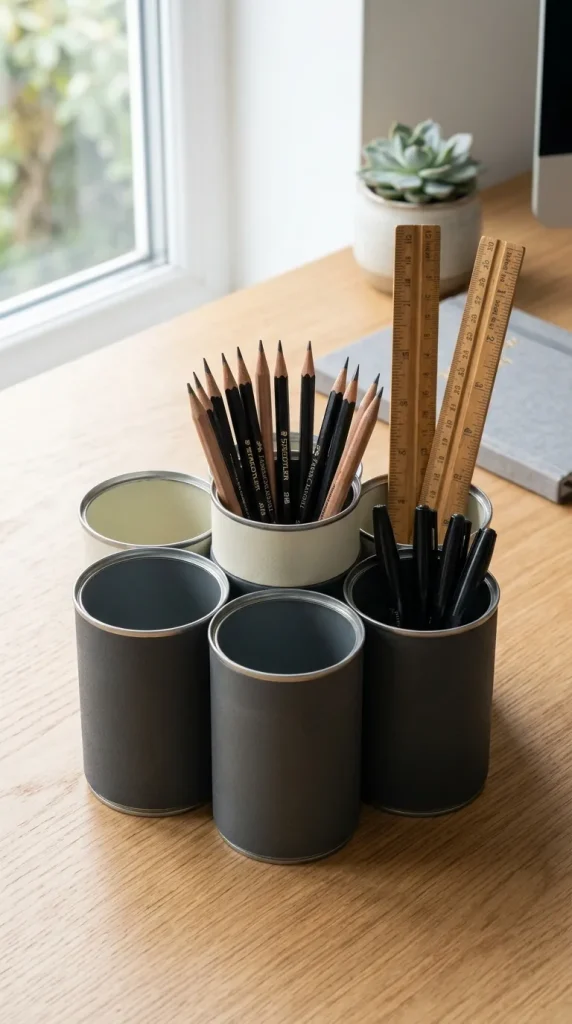
The magnetic hexagonal honeycomb tin can cluster combines modular versatility with industrial efficiency, allowing individual cans to detach and rearrange across a geometric desktop matrix. This design utilizes seven standard soup cans wrapped in matte monochromatic tones, clustered around a central core to form a balanced six-sided honeycomb shape. Rare-earth neodymium magnets are adhered between the cans, allowing the organizer to lock firmly into a solid unit during daily use while allowing individual canisters to be pulled away for focused task work across your desk. The compact geometric arrangement maximizes internal tool capacity while maintaining a remarkably small desktop footprint. The modern minimalist aesthetic looks intentional and refined, turning simple food cans into a contemporary architectural desk sculpture.