Introduction
Transforming fresh garden blooms into pressed dried flower glass frame wall art preserves the delicate beauty of botanicals inside modern floating displays. Enclosing real pressed petals, ferns, and wild grasses between two panes of clear glass creates a suspended, translucent effect that catches natural light and reveals fine petal veins and organic leaf contours. Instead of relying on printed botanical posters, crafting handmade herbarium frames allows you to preserve meaningful garden harvests, wedding bouquets, and seasonal wild clippings with archival longevity. This comprehensive guide details the foundational mechanics of botanical pressing, moisture extraction, glass layout composition, and adhesive-free mounting across ten unique design styles. You will explore critical techniques for selecting colorfast floral specimens, choosing between traditional wooden press books and silica gel, sealing double-glass frames, and preventing UV sun bleaching. Master botanical anatomy, geometric spacing, color preservation, and frame mechanics to turn delicate garden clippings into heirloom-quality framed art for your home.
Why This Idea Is Trending or Useful
Pressed dried flower glass frame wall art has become a favorite across modern interior design, biophilic decor, and sustainable crafting communities because it bridges natural botanical beauty with minimalist framing. Transparent floating glass frames eliminate heavy paper backings, allowing the underlying wall color and room light to shine directly through the negative space around each pressed petal. This lightweight, see-through aesthetic complements a wide range of interior styles—from organic Scandinavian living rooms and Japandi spaces to dark academia libraries and minimalist entryways. Crafting pressed floral frames also provides an eco-friendly, zero-waste outlet for preserving sentimental flora: wedding florals, memorial garden blossoms, graduation bouquets, and travel wildflowers can be immortalized rather than discarded. Furthermore, flat-pressed botanical framing requires minimal wall depth, making it ideal for narrow hallways, stairwells, and small apartment alcoves. The combination of zero-footprint transparency, sentimental preservation value, low craft startup costs, and timeless organic charm makes pressed flower glass framing an essential creative project.
Materials and Preparation
Building crisp, archival-quality pressed flower glass frames requires collecting colorfast botanical specimens, moisture-absorbent pressing supplies, clear floating frames, and precision handling tools before arranging your artwork. Essential crafting materials include assorted fresh garden flowers and foliage (such as pansies, cosmos, larkspur, delphiniums, baby’s breath, and maidenhair ferns), archival blotting paper or non-glossy phonebook pages, a heavy wooden flower press or stack of heavy hardcover books, double-pane floating glass frames with brass, black metal, or natural wood borders, and archival clear floral glue or micro-glue dots. Required tools include precision craft tweezers, a sharp utility knife, an artist brush with soft bristles, lint-free microfiber glass cloths, and isopropyl alcohol. Begin preparation by harvesting fresh blooms in the late morning after dew has completely evaporated but before hot midday sun wilts the petals; dry surface petals prevent mold growth during pressing. Inspect blossoms for flat facial profiles, trimming thick stem backs or separating multi-layered petals (such as thick roses or dahlias) into individual petal layers. Place flowers face down between sheets of archival blotting paper inside your wooden press, tighten the straps firmly, and let them dry undisturbed in a warm, dark, well-ventilated room for two to three weeks until the petals are paper-thin, crisp, and moisture-free.
Idea 1: Minimalist Floating Fern and Wildflower Herbarium Specimen
Setup Method
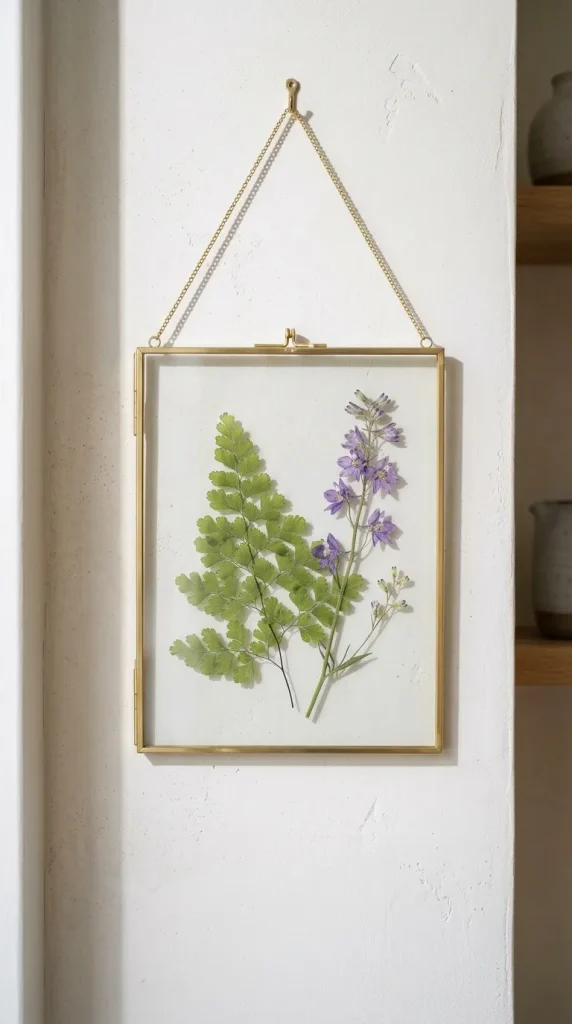
The minimalist floating fern and wildflower herbarium specimen showcases individual pressed botanical clippings suspended cleanly in clear glass, inspired by historical 19th-century naturalist archives. This design highlights the natural silhouette of a single graceful botanical—such as a vibrant green maidenhair fern frond, a slender stem of purple larkspur, or a delicate sprig of wild chamomile. Floating the single stem in the center of an oversized glass frame emphasizes negative space, turning fine leaf serrations and delicate stem curves into a refined botanical study. Finished in a slender brass or black metal floating frame, this piece brings clean botanical elegance to modern living rooms, bathrooms, and study spaces.